
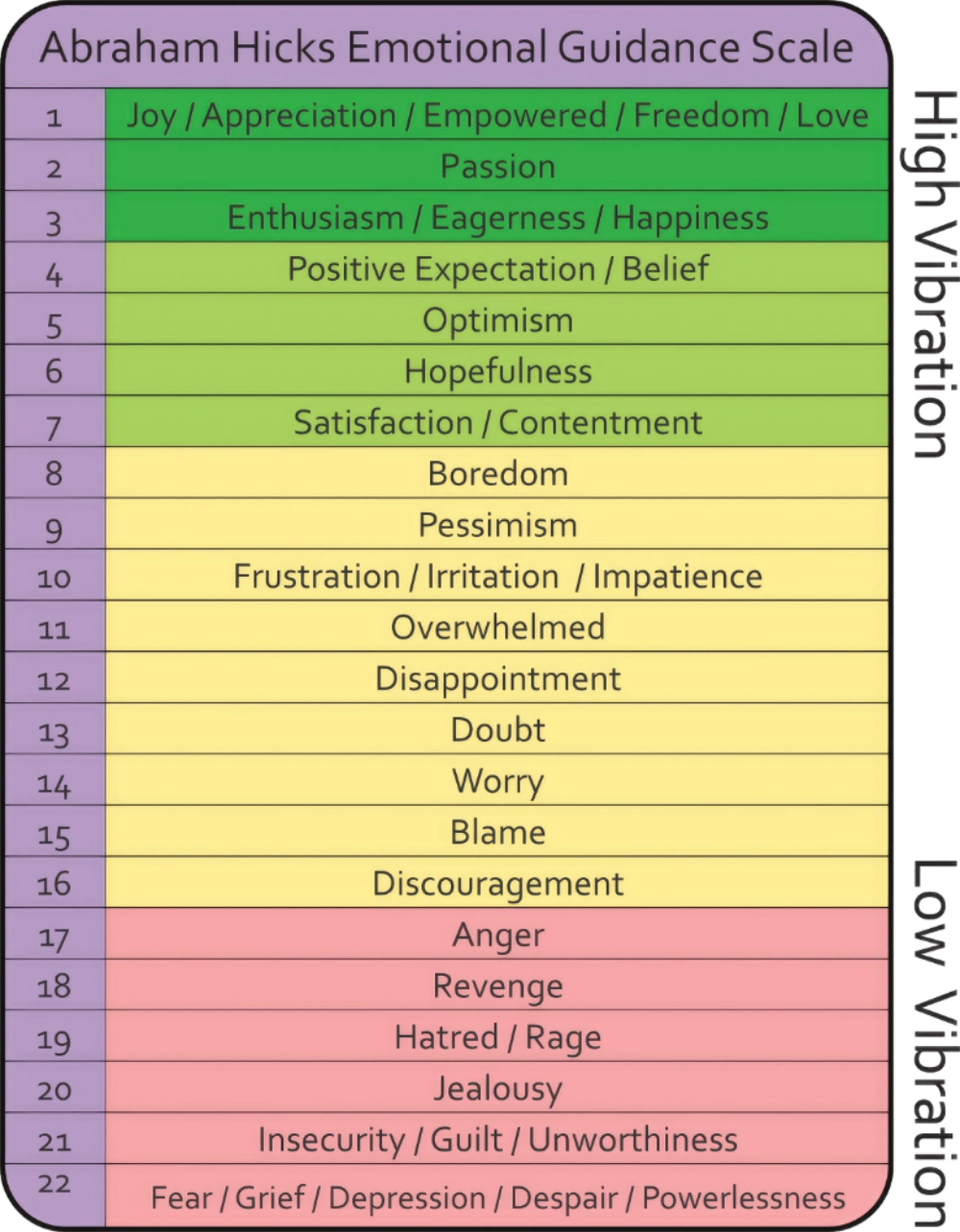
| Emotions are powerful indicators of our mental and spiritual states. They guide our thoughts, decisions and interactions. Yet, navigating through emotions that either trigger us or engage us in negative thinking, is challenging. Enter the Emotional Guidance Scale, a tool Esther and Jerry Hicks popularised. This scale is not only a guide for emotional self-awareness but also a practical framework to climb from despair to empowerment one step at a time. This Guidance Scale organises emotions in a spectrum from the most negative, like fear and despair, to the most positive, like joy and empowerment. The goal isn’t to leap from negative to positive emotions instantly but to gradually move up the scale toward ‘better-feeling’ emotions. Each step on the scale represents a different emotional frequency. Your job is to identify where you currently stand and consciously aim for the next better-feeling emotion. This scale is a tool for self-awareness and emotional regulation. By identifying your current emotional state, you can take active steps to a more uplifting state without the pressure of ‘forcing’ happiness. HOW TO USE THE EMOTIONAL GUIDANCE SCALE Identify where you are. Pause and reflect on your current emotional state. Name your emotion and find it on the scale. Acknowledge and accept how you feel. Avoid judging yourself for feeling ‘negative.’Every emotion serves a purpose. Accepting how you feel is the first step to change. Reach for the next emotion. Once you pinpoint your current emotion, think about how you can shift slightly upward. Take small steps Each time you can shift an emotion, and celebrate your progress. Practice Patience Emotional shifts take time. Rather focus on consistent progress. If you follow this scale you can shift your relationships at work and home. When challenged, refer to this scale and gradually climb higher. The Emotional Guidance Scale is a powerful reminder that emotional well-being is a process, not a destination. |
